

-
 Agenda 2063
-
 Circular Economy
-
 Climate Resilience & Adaptation
-
 Renewable Energy & Transition
-
Biodiversity
-
Sustainable Finance
-
 Governance & Sustainable Business
-
 Green Tech
-
Carbon Credits & Markets
-
Social Responsibility
-
Carbon, Net Zero & Decarbonisation
-
Health & Well-being
-
 Equity, Diversity & Inclusion
-
Sustainable Construction
-
Sustainable Lifestyle
-
Sustainable Fashion
-
Environmental Law & Policy
-
Environmental Responsibility
-
Marine & Oceans
-
Plastics
-
Sustainable Marketing & Communications
-
Sustainable Cities
-
Women & Gender
-
Workplace Culture
-
Stakeholder Engagement
-
Waste Management
-
Sustainable Development
-
Climate Diplomacy
-
Water, Sanitation & Hygiene
-
Sustainable Land Use
-
Sustainable Agriculture
-
Sustainable Aviation
-
Environmental, Social & Governance (ESG)
-
Sustainability Management
-
Sustainability Reporting
-
Education for Sustainable Development
-
Sustainability Strategy
-
Sustainable Supply Chains
-
Sustainable Procurement
-
Sustainable Logistics
-
Future of Work Skills
-
Business
-
Marketing
-
Lifestyle
-
Health & Fitness
-
Academics
-
Design








CSRD Explained for African Businesses: What You Need to Know Now
The Brussels Effect in Africa: How EU CSRD Regulations Impact Exporting Businesses and the Strategic Steps Needed to Protect Your Market Access.
The EU's CSRD is reshaping access to European markets. Explore what the latest 2026 regulatory changes mean for African exporters and supply chains.
There is a regulation in Brussels that African businesses did not vote for, were not consulted on, and do not appear in the scope of; however, it is quietly reshaping the conditions under which African companies can access European markets, attract international capital, and sustain export relationships with the continent's largest trading partner.
It is called the Corporate Sustainability Reporting Directive (CSRD), and if your business exports to Europe, sources from European supply chains, or seeks investment from European institutions, you are already inside its orbit, whether you know it or not. This article is for African business leaders, corporate executives, SME owners, procurement managers, and export strategists who need to understand what the CSRD is, what it has recently become, and what it concretely demands of African enterprises that want to remain competitive in the global economy.
What the CSRD Is, and Why It Exists
The Corporate Sustainability Reporting Directive entered into force in January 2023, replacing the EU's Non-Financial Reporting Directive (NFRD) and expanding the scope and rigour of corporate sustainability disclosure in Europe. At its core, the CSRD requires companies to report detailed, audited information on how their operations affect and are affected by environmental, social, and governance (ESG) factors. The underlying logic is straightforward: the EU has committed to net-zero emissions by 2050 and to protecting human rights across global value chains. To hold companies accountable to those commitments, it needs standardised, comparable, and externally assured sustainability data. The CSRD is the instrument that produces that data. Companies subject to the CSRD must report under the European Sustainability Reporting Standards (ESRS), which is a detailed set of disclosure requirements covering climate change, pollution, water and marine resources, biodiversity, resource use, workers' rights, community impacts, business ethics, and governance. The level of specificity is substantial. This is not a box-ticking exercise. It is structured, quantitative, third-party assured disclosure and closer in rigour to financial reporting than to traditional corporate social responsibility communications.
The Omnibus Revision: What Changed in February 2026
Before going further, it is important to acknowledge a significant development. On 26 February 2026, the EU formally published Directive 2026/470, known as the Omnibus I Directive, which substantially narrowed the CSRD's scope as part of a broader EU competitiveness simplification agenda. Under the revised rules, CSRD mandatory reporting now applies to companies with more than 1,000 employees and a net annual turnover above €450 million. The original thresholds, which would have captured companies with 250+ employees under a much broader scope, have been raised. Listed SMEs are no longer automatically in scope, and critically for non-EU businesses, the threshold for third-country parent undertakings generating EU-based turnover has been set at €450 million for the parent company and €200 million for a subsidiary or branch. This is a meaningful reduction in the directive's formal reach. While commentators have described it as relief for smaller businesses, underscoring it this way is partially correct and may significantly mislead African companies.
Why the Narrowing Does Not Narrow the Risk for African Businesses
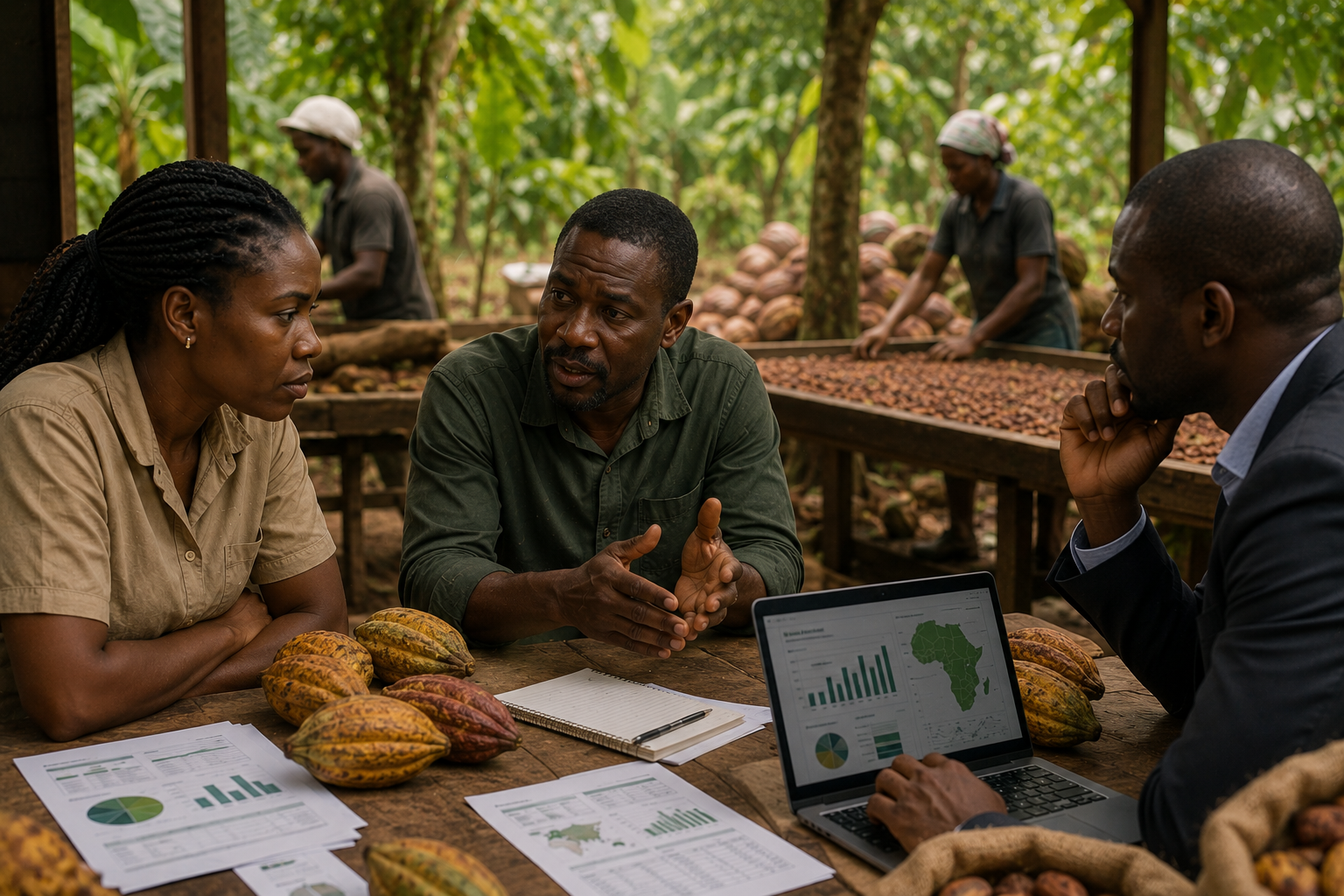
The Omnibus revision does not alter the compliance obligations of the large European companies that remain in scope, and those companies that source from Africa. This is the mechanism African business leaders must internalise. The CSRD's sustainability reporting requirements for large European companies include Scope 3 emissions, the indirect emissions that occur upstream and downstream in a company's value chain. When a European chocolate manufacturer with revenues above €450 million is required to disclose the sustainability performance of its cocoa supply chain, it must gather data from the farmers, co-operatives, and exporters in Ghana, Côte d'Ivoire, and Nigeria that feed that supply chain. The compliance obligation is on the European company, but the data requirement falls on the African supplier.
The CSRD also introduced a value-chain cap under the Omnibus revision, a protective measure that limits how much information large companies can demand from SMEs in their supply chains. However, the cap applies to the volume of data requests, not to the legitimacy of the requests themselves. African suppliers to European buyers will still face structured ESG questionnaires, sustainability audits, and documentation requests. The question is whether they have the internal capacity to respond credibly. For example, consider the stakes concretely. Cocoa directly employs more than 800,000 farmers in Ghana and over one million in Côte d'Ivoire. Coffee provides livelihoods for approximately 15 million farmers in Ethiopia, and nearly 2 million in Kenya, and the EU is the primary destination for these exports. The European companies importing these commodities are within the CSRD's scope. Their sustainability reports, including supply chain due diligence, are publicly disclosed, audited, and increasingly scrutinised by investors, regulators, and NGOs. An African supplier that cannot provide credible sustainability data is a liability to a European buyer trying to produce a compliant CSRD report, and a liability in a supply chain tends not to remain in that supply chain for long.
What CSRD Readiness Actually Requires of African Businesses
CSRD readiness is not a single action but a set of internal capacities that African companies must build progressively and with urgency.
Sustainability data systems. The foundational requirement is the ability to measure, record, and report ESG metrics: greenhouse gas emissions (Scope 1 and Scope 2 at minimum; Scope 3 increasingly expected), water consumption, waste generation, labour practices, land use, and governance structures. Most African SMEs currently have no systematic approach to collecting this data. Building that system, even in a basic form, is the first and most critical step.
Traceability infrastructure. For commodity exporters, particularly in agriculture and extractives, the ability to trace product from point of origin to point of export is becoming a market-access requirement. Ghana and Côte d'Ivoire are both building national cocoa traceability systems, a recognition that traceability is no longer optional. Ethiopian coffee exporters face the same challenge: the Ethiopian Coffee Exporters Association has noted that geolocating the five million smallholder households supplying the export chain may take years. That is a years-long vulnerability in a market that is already demanding answers.
Human rights due diligence documentation. The CSRD's companion directive, the Corporate Sustainability Due Diligence Directive (CSDDD), also revised under Omnibus I, with member state transposition required by July 2028, requires large EU companies to identify, prevent, and report on human rights and environmental risks in their supply chains. For African suppliers, this means being prepared to demonstrate that their operations do not involve child labour, forced labour, unsafe working conditions, or environmental violations.
ESG reporting competency. All the above require human capacity that African organisations currently lack at scale. Sustainability analysts, ESG data managers, supply chain auditors, and disclosure specialists are in short supply across the continent. This is where skills development is not a soft investment but a market access enabler.
The Opportunity Inside the Obligation
Let me be direct about something that often gets lost in the compliance framing: the CSRD is not only a burden. For well-prepared African businesses, it is a competitive differentiation tool. The African companies that move now to build internal ESG data systems, develop supply chain traceability, train sustainability teams, and produce credible voluntary sustainability disclosures aligned with GRI or IFRS S1/S2 standards will be the suppliers that European buyers prioritise as CSRD compliance pressure mounts. They will be the counterparties that international development finance institutions can deploy capital to without lengthy due diligence delays. They will be the enterprises that access sustainability-linked trade finance at preferential rates. They will be the businesses that African regulators, whose own sustainability disclosure requirements are rapidly developing, can hold up as models. Sustainability readiness, in this environment, is market readiness, as well as export readiness.
What You Should Do Right Now
If you are a large African corporation exporting to Europe or seeking European investment, you must commission an ESG readiness assessment against ESRS baseline requirements. Identify the data gaps, build a three-year disclosure roadmap, train your sustainability team on the specific regulatory instruments, CSRD, CSDDD, the EU Taxonomy, the EUDR, etc., that govern your sector's access to European markets. If you are an African SME in a European supply chain, you must understand the questionnaires your buyers are sending. Those questions are CSRD-driven. Begin collecting the data they request, even informally and document your practices. The businesses that respond with structured evidence will outcompete those that cannot respond at all. If you are a professional building a career in African sustainability, the CSRD is one of the most important regulatory instruments shaping demand for your skills. Understanding it, not in its abstract European design, but in its practical application to African supply chains, commodity sectors, and financial markets, is the difference between advisory competency and genuine expertise.
At SSCLAfrica, we teach CSRD and the European sustainability regulatory architecture specifically as it applies to African businesses, grounded in African supply chains, African export sectors, and the African regulatory environment that is responding to these global pressures, as understanding a European directive through European eyes will not prepare you to apply it through African hands. The CSRD is not coming, and for many African businesses, it is already here. The question is whether your organisation is ready to meet it.

More from Enoch Opare Mintah

The Green Skills Every ...
23 Apr 2026
How HR Can Build a Green-Ready ...
23 Apr 2026
Top 20 Green Jobs Growing in ...
16 Jun 2026
Comments
Subscribe to Our Newsletter


Additional Links
Login Register Contact Certificate Validation Become Instructor About Terms and PoliciesContact US


Reply to Comment