
-
 Agenda 2063
-
 Circular Economy
-
 Climate Resilience & Adaptation
-
 Renewable Energy & Transition
-
Biodiversity
-
Sustainable Finance
-
 Governance & Sustainable Business
-
 Green Tech
-
Carbon Credits & Markets
-
Social Responsibility
-
Carbon, Net Zero & Decarbonisation
-
Health & Well-being
-
 Equity, Diversity & Inclusion
-
Sustainable Construction
-
Sustainable Lifestyle
-
Sustainable Fashion
-
Environmental Law & Policy
-
Environmental Responsibility
-
Marine & Oceans
-
Plastics
-
Sustainable Marketing & Communications
-
Sustainable Cities
-
Women & Gender
-
Workplace Culture
-
Stakeholder Engagement
-
Waste Management
-
Sustainable Development
-
Climate Diplomacy
-
Water, Sanitation & Hygiene
-
Sustainable Land Use
-
Sustainable Agriculture
-
Sustainable Aviation
-
Environmental, Social & Governance (ESG)
-
Sustainability Management
-
Sustainability Reporting
-
Education for Sustainable Development
-
Sustainability Strategy
-
Sustainable Supply Chains
-
Sustainable Procurement
-
Sustainable Logistics
-
Future of Work Skills
-
Business
-
Marketing
-
Lifestyle
-
Health & Fitness
-
Academics
-
Design








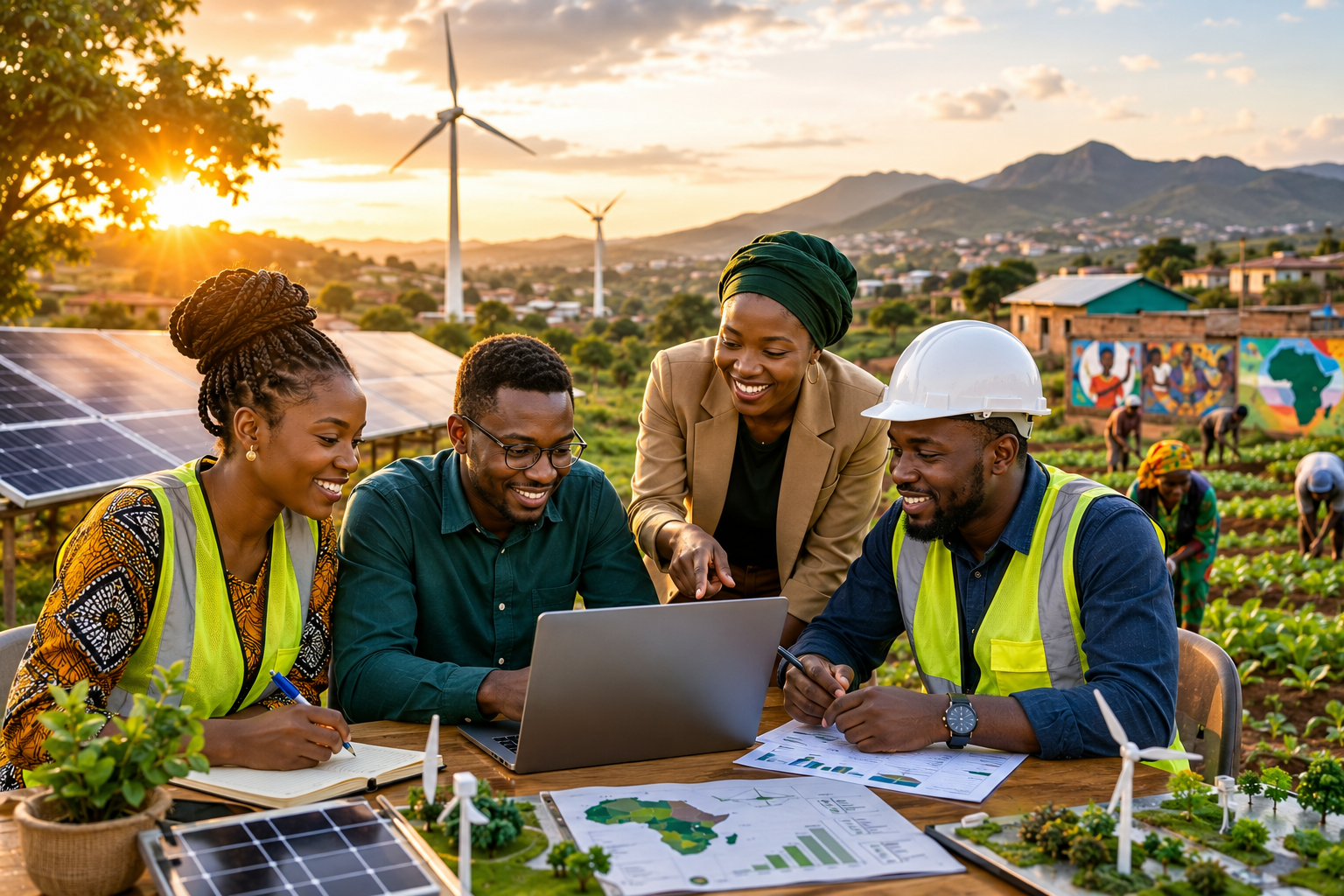
The $2.8 Trillion Opportunity: Africa's Green Economy and the Skills It Needs
Unlocking the $2.8 Trillion Frontier: The Real-World Green Skills Africa Needs to Capture the World’s Largest Economic Opportunity.
A $2.8 trillion green economy is heading for Africa, but capital follows competency. Explore the specific high-skill roles required to claim this future.
There is a number that every African professional, business leader, and policymaker should have fixed in their minds: $2.8 trillion. That is the Climate Policy Initiative's estimate of what Africa requires between 2020 and 2030 to meet its commitments under the Paris Agreement to build the renewable energy infrastructure, the climate adaptation systems, the nature-based solutions, and the green industrial base that will determine whether this continent thrives or is overwhelmed by the climate crisis it did least to create. While this is a staggering figure, it is also the single largest economic opportunity in Africa's modern history.
The question is not whether that capital will flow. Private capital is already in motion searching for exactly the kind of large-scale, high-integrity, long-duration green projects that Africa's renewable energy potential, carbon sinks, critical minerals, and green hydrogen resources represent. The question is whether Africa has the skilled human capacity to deploy it, structure it, govern it, and capture its value before that capital finds its way to more prepared markets elsewhere. The answer, right now, is no, and changing that answer is the most urgent economic task on the continent.
What the $2.8 Trillion Actually Represents
It is important to understand this figure in its full dimension, because it is not a single funding line. It is the aggregate of several overlapping capital streams, each with its own mechanisms, instruments, and professional requirements.
Climate finance for mitigation and adaptation: The largest share covers the shift to low-carbon energy systems, including solar, wind, hydropower, green hydrogen, and the infrastructure needed to adapt to climate impacts such as flood defences, drought-resilient agriculture, coastal protection, and water security systems. The African Development Bank, the Green Climate Fund, and a growing portfolio of development finance institutions are the primary public channels; however, public finance alone is structurally insufficient. Closing the gap requires the mobilisation of private capital at scale through blended finance structures, green bonds, sustainability-linked loans, and infrastructure investment vehicles that private institutional investors can access.
Carbon markets: Africa holds extraordinary carbon sequestration potential from forests, wetlands, grasslands, and marine ecosystems that collectively absorb over 600 million tonnes of carbon dioxide annually. Yet Africa accounts for only 13.4% of credits issued by the largest voluntary offset registries, and the continent has historically captured a fraction of the economic value its natural carbon sinks represent. The Africa Carbon Markets Initiative projects that voluntary carbon markets alone could generate $6 billion annually for Africa by 2030 and support 30 million livelihoods. Article 6 of the Paris Agreement, which provides the framework for bilateral carbon credit trading between countries and establishes the Paris Agreement Crediting Mechanism, is the regulatory architecture that could activate this potential. Countries including Zambia, Zimbabwe, Uganda, and Malawi are already developing Article 6 frameworks. The opportunity is real; however, structuring, verifying, and trading high-integrity African carbon credits at scale requires professionals who do not yet exist in sufficient numbers.
Critical minerals: The global energy transition runs on lithium, cobalt, manganese, copper, and rare earth elements, and Africa holds extraordinary concentrations of all of them. The DRC led the world in cobalt production in 2024 and ranked second in copper. Zimbabwe, Mali, Ghana, and Namibia are among the leading lithium producers. African governments, including the DRC, have moved aggressively to capture more value through export restrictions and processing mandates rather than shipping raw ore. This is the right strategic instinct, but beneficiation of processing minerals into battery-grade materials, EV components, and clean energy technologies domestically requires industrial capacity, environmental governance, and technical expertise that must be built.
Green hydrogen: Africa's solar irradiation levels and wind resources give it among the lowest projected production costs for green hydrogen globally. The African Energy Chamber's 2026 Outlook projects that Africa could produce over 9 million tonnes of low-carbon hydrogen annually by 2035. Morocco, Namibia, South Africa, and Egypt have the most advanced green hydrogen strategies. Europe is already negotiating bilateral agreements to secure an African green hydrogen supply. The economic potential is immense, but so is the technical, regulatory, and financial structuring complexity involved in developing it.
The Capital Is Searching for Competency
The global green economy is projected to reach $10 trillion by 2030. Africa's share of that economy is currently far below what its resource endowment, geographic position, and population scale should command. The reason is not a lack of assets. It is a chronic, compounding shortage of the skilled professionals needed to translate those assets into bankable, investable, governable green economy value.
Consider what deploying green capital in Africa actually requires. A solar IPP project in Nigeria requires environmental and social impact assessors, project finance analysts who understand blended concessional structures, ESG compliance officers who can satisfy the reporting requirements of European development finance institutions, and community liaison professionals who can navigate local land rights and benefit-sharing frameworks. A carbon credit project in the DRC requires biodiversity specialists, carbon accountants trained in Verra or Gold Standard methodologies, legal professionals fluent in Article 6 authorisation processes, and data systems specialists who can build the monitoring, reporting, and verification infrastructure that international buyers require. A green bond issuance by a Kenyan municipality requires sustainable finance structuring expertise, second-party opinion advisors, and investor relations professionals who can communicate climate credentials to institutional investors in London and Tokyo. None of these roles can be filled by importing consultants indefinitely. Each represents a professional capability that Africa must build domestically, at scale, with urgency or watch the $2.8 trillion flow to projects that can be structured, governed, and reported to international standards by teams that already exist.
Africa currently receives only 3% of global clean energy investment. That figure is not a reflection of Africa's potential. It is a reflection of Africa's current capacity to absorb and deploy that investment credibly, and building the skills changes the number.
The Skills the Green Economy Actually Needs
The profile of the professional Africa's green economy requires is specific, and it is not being produced by the current education and training ecosystem at anywhere near the required rate.
At the technical layer: solar and wind engineers, hydropower operations specialists, battery technology technicians, green hydrogen process engineers, and climate-smart agriculture practitioners. At the financial layer: green bond structurers, blended finance specialists, carbon market analysts, climate risk modellers, and sustainable investment advisors. At the governance and compliance layer: ESG reporting managers, environmental and social safeguard specialists, carbon project validators, Article 6 authorisation advisors, and sustainability due diligence professionals. At the policy and strategy layer: green industrial policy advisors, climate NDC implementation specialists, and just transition planners who can navigate the social equity dimensions of rapid economic decarbonisation. FSD Africa and BCG's research projects 3.3 million new direct green jobs across the continent by 2030, with 60% being skilled or white-collar roles. The Mastercard Foundation's 2025 analysis confirms that 1.5 to 3.3 million green jobs are forming in renewable energy, climate-smart agriculture, and ESG analytics. These projections are not aspirational. They are demand forecasts and are already ahead of supply.
What Closing the Gap Requires
The skills gap behind the $2.8 trillion opportunity has a structural cause: Africa's professional training ecosystem, particularly in sustainability and green finance, has been built on imported content designed for foreign regulatory environments and foreign capital markets. As I have argued elsewhere, the cognitive translation burden imposed on African professionals learning through European or North American frameworks is not a minor inconvenience. It is a systematic drag on the pace at which Africa can build green economy competency.
Closing that gap requires training infrastructure built on African realities, courses that teach carbon market structuring through the lens of Article 6 bilateral agreements being developed in Zambia and Zimbabwe, not the EU Emissions Trading System; green bond frameworks taught through the experience of the African Development Bank's green bond programme and the Johannesburg Stock Exchange's sustainability segment; climate risk modelling calibrated to sub-Saharan African physical geographies and commodity-dependent economic structures.
This is precisely what SSCLAfrica exists to build. A green skills infrastructure designed from the ground up for the continent where those skills will be applied. The $2.8 trillion is not a number to admire from a distance. It is a mobilisation instruction, and Africa has the assets, the renewable potential, the carbon sinks, the critical minerals, and critically, the human talent to capture a transformative share of the global green economy now forming around us. What Africa needs now, urgently and at scale, is the green skills to claim it.

More from Enoch Opare Mintah

Every Desk is a Green Desk: ...
23 Apr 2026
CSRD Explained for African ...
17 Jun 2026
How HR Can Build a Green-Ready ...
23 Apr 2026
Comments
Subscribe to Our Newsletter


Additional Links
Login Register Contact Certificate Validation Become Instructor About Terms and PoliciesContact US


Reply to Comment