



-
 Agenda 2063
-
 Circular Economy
-
 Climate Resilience & Adaptation
-
 Renewable Energy & Transition
-
Biodiversity
-
Sustainable Finance
-
 Governance & Sustainable Business
-
 Green Tech
-
Carbon Credits & Markets
-
Social Responsibility
-
Carbon, Net Zero & Decarbonisation
-
Health & Well-being
-
 Equity, Diversity & Inclusion
-
Sustainable Construction
-
Sustainable Lifestyle
-
Sustainable Fashion
-
Environmental Law & Policy
-
Environmental Responsibility
-
Marine & Oceans
-
Plastics
-
Sustainable Marketing & Communications
-
Sustainable Cities
-
Women & Gender
-
Workplace Culture
-
Stakeholder Engagement
-
Waste Management
-
Sustainable Development
-
Climate Diplomacy
-
Water, Sanitation & Hygiene
-
Sustainable Land Use
-
Sustainable Agriculture
-
Sustainable Aviation
-
Environmental, Social & Governance (ESG)
-
Sustainability Management
-
Sustainability Reporting
-
Education for Sustainable Development
-
Sustainability Strategy
-
Sustainable Supply Chains
-
Sustainable Procurement
-
Sustainable Logistics
-
Future of Work Skills
-
Business
-
Marketing
-
Lifestyle
-
Health & Fitness
-
Academics
-
Design








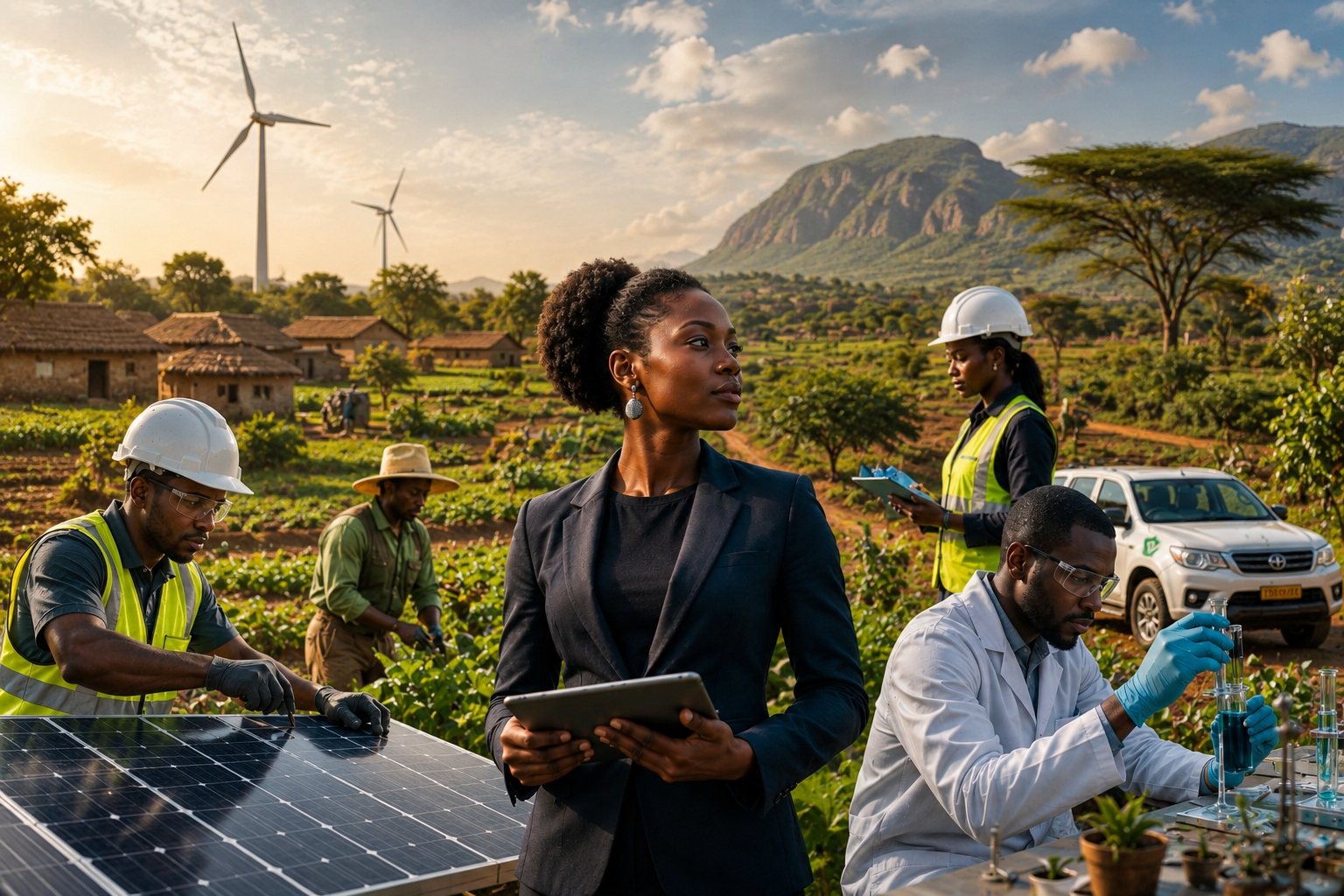
Top 20 Green Jobs Growing in Africa in 2026
The Data-Driven Map of Africa’s Fastest-Growing Green Careers and the Skills Needed to Secure Them.
Explore the 20 fastest-growing green jobs in Africa for 2026. Discover the high-skill careers driving the continent's economy and how to bridge the skills gap.
Africa is not waiting for the green economy to arrive. It is already here, and it is hiring.
FSD Africa and Shortlist, with analysis by the Boston Consulting Group, project 3.3 million new direct green jobs across the continent by 2030. The renewable energy sector alone accounts for up to 2 million of those roles, with solar contributing 1.7 million. Agriculture and nature-based sectors add a further 700,000. Critically, 60% of the employment generated by Africa's green economy over the coming years will be skilled or white-collar in nature. These are not informal, low-wage roles. They are professional, technical, and knowledge-intensive careers, and the window to build the competency required to fill them is now.
What follows is not a speculative list. It is a map of the roles that are actively forming, backed by data, driven by regulation, and constrained, critically, by a shortage of trained African talent. Each one represents a career pathway that SSCLA Africa was built to open.
1. Solar Energy Technicians: Solar is the continent's single largest green job creator. South Africa projects 140,000 solar jobs; Kenya, 111,000. Installation, maintenance, and grid integration are driving demand at scale from Lagos to Lusaka.
2. Solar Project Developers: Beyond installation lies the financing, permitting, and procurement that make projects happen. As utility-scale and mini-grid solar accelerate, developers with both technical and commercial literacy are in acute shortage.
3. Wind Energy Engineers: South Africa's Renewable Energy Independent Power Producer Procurement Programme (REIPPPP) has already generated over 40,000 jobs and attracted USD 14 billion in investment. Wind is a growing slice of that portfolio, particularly in the Eastern and Northern Cape.
4. Hydropower Operations Specialists: Hydroelectricity is forecast to be the leading green employer in Ethiopia (33,000 jobs) and the DRC (16,000 jobs). Managing, maintaining, and optimising Africa's significant hydro infrastructure requires a specialised workforce that remains underdeveloped.
5. Corporate ESG roles: spanning ESG Analysts, Sustainability Managers, Chief Sustainability Officers, ESG Reporting Specialists, Climate Risk Analysts, Sustainability Marketers and Sustainable Finance Officers, are among the fastest-growing globally and on the continent, and African professionals are increasingly being sought to support both domestic and international firms.
6. Sustainability Reporting Professionals/Managers: As IFRS S1/S2 sustainability disclosure standards, the GRI framework, and the EU Taxonomy embed themselves into African corporate reporting requirements, the demand for professionals capable of managing the full disclosure cycle, from data collection, materiality assessment, stakeholder reporting, to assurance coordination, is accelerating sharply.
7. Climate Risk Consultants: Physical and transition climate risks are no longer abstract. African financial institutions, insurers, and development finance institutions are embedding climate risk assessment into credit decisions, portfolio management, and strategic planning. Professionals trained in TCFD-aligned risk methodologies, calibrated to African geographies and commodity exposures, are in strong demand.
8. Carbon Markets Specialists: Africa holds 17% of the world's forests and has an extraordinary carbon sequestration potential. As voluntary carbon markets mature and Article 6 of the Paris Agreement frameworks activate, professionals capable of structuring, verifying, and trading carbon credits within African project contexts are moving from niche to essential.
9. Green Finance Advisors: The Climate Bonds Initiative estimates Africa requires USD 2.8 trillion in climate finance through 2030. Deploying that capital requires professionals who can structure green bonds, sustainability-linked loans, and blended finance instruments and who understand the regulatory and market environment of the African economies where those instruments will be deployed.
10. Climate-Smart Agriculture Specialists: Agriculture and nature-based sectors are forecast to generate up to 700,000 green jobs, with over 377,000 coming from climate-smart agricultural technologies alone. In Ethiopia, where 85% of youth work in agriculture, climate-smart interventions are transforming yields and conservation simultaneously. Kenya's Twiga Foods model, connecting smallholders to markets through digital platforms, illustrates what this sector looks like at a commercial scale.
11. Sustainable Supply Chain Managers: The EU Deforestation Regulation creates immediate compliance obligations for African cocoa, palm oil, timber, and coffee exporters. Professionals who can audit, map, and certify sustainable supply chains, translating international compliance requirements into African field-level operations, are among the most urgently needed in West and East Africa.
12. E-Mobility Engineers: Kenya launched its National Electric Mobility Policy in February 2026. Rwanda has banned petrol motorcycles in Kigali. Ethiopia led the world with an ICE vehicle import ban in 2024. Morocco and Egypt are investing billions in EV manufacturing. The engineering talent required to design, assemble, and maintain Africa's electric transport fleet is in the process of forming, and the jobs are active now.
13. Battery Technology Technicians: Africa holds 70% of the world's cobalt and significant lithium reserves. As EV adoption and battery storage for off-grid renewable systems scale, the technicians capable of managing, servicing, and ultimately recycling battery systems are a structurally critical workforce category.
14. Green Building Designers / Sustainable Construction Managers: Africa's urban population is projected to double by 2050, adding roughly 950 million people to its cities. Every building constructed in that expansion is a choice about embedded carbon, energy demand, and material circularity. Green building standards, including EDGE, LEED, and South Africa's Green Star, are driving demand for designers and project managers trained in low-carbon construction.
15. Circular Economy Specialists: Rwanda's USD 72 million waste management facility is scheduled for 2026. Kenya is developing the USD 6 billion Kakamega Waste-to-Energy Plant. Ghana, Ethiopia, and Nigeria all have active waste-to-energy infrastructure in development. The specialists who can design, manage, and optimise circular systems, from waste recovery to materials reuse, are a growing professional category across the continent.
16. Waste-to-Energy Project Managers: Distinct from broader circular economy roles, waste-to-energy project management requires specific competency in technology procurement, community stakeholder engagement, regulatory navigation, and operations, which are skills that are not yet widely available in the African market.
17. Nature-Based Solutions (NbS) Practitioners: From ecosystem restoration and watershed management to blue carbon and biodiversity credits, nature-based solutions are emerging as a significant sector within Africa's green economy. FSD Africa projects 30,000–115,000 jobs in ecosystem conservation and NbS through 2030, roles that require both ecological knowledge and financial structuring skills.
18. Environmental and Social Governance (ESG) Compliance Officer: Beyond reporting lies governance. Boards, executive teams, and audit committees across African-listed companies are under increasing pressure from domestic regulators (Nigeria's SEC, the Ghana Stock Exchange, the Nairobi Securities Exchange) and international investors to demonstrate that ESG governance is embedded in operations, not merely disclosed on paper. Compliance officers who can operationalise that governance are a new but fast-growing role category.
19. AI-Enabled Sustainability Data Analysts: Workers with green skills command a 54.6% higher hiring rate than those without, and the premium is growing for those who can combine sustainability competency with data fluency. Across African organisations, the demand for professionals capable of collecting, validating, and analysing sustainability data, including AI-assisted climate modelling and ESG data management platforms, is accelerating.
20. Sustainability Educators and Trainers: The green workforce does not build itself. As African organisations, governments, universities, and professional bodies recognise the depth of the green skills deficit, the demand for qualified sustainability educators, particularly those able to teach in African regulatory contexts with African case studies, is itself a growing professional market.
The Skills Gap Behind Every Job on This List
Every role above has something in common: the trained African talent available to fill it is insufficient to meet current demand, let alone the demand of 2030.
This is not because African professionals lack aptitude. It is because the training infrastructure has not kept pace with the market. The sustainability curricula available to most African learners were designed in Europe, for European regulatory contexts, illustrated with European case studies. Before an African professional can apply what they have been taught, they must first spend significant cognitive and professional energy translating it into their own reality, which I have called elsewhere the cognitive translation barrier. That barrier is not an inconvenience but a structural drag on Africa's green economy.
SSCLAfrica was built to remove it.
Every course on the platform is designed from the ground up for African regulatory environments, that is, grounded in the Nigerian SEC, the Ghana Stock Exchange guidelines, the Nairobi Securities Exchange disclosure requirements, South Africa's King IV code, and the African Union's Agenda 2063 framework. Every concept is illustrated with African case studies: from Ghanaian cocoa supply chains, Kenyan renewable energy projects, Nigerian ESG governance, to Moroccan solar infrastructure. Every category on the list above has a corresponding learning pathway on the platform. The 20 jobs in this article are not aspirational but present. The organisations hiring for them in Accra, Nairobi, Lagos, Johannesburg, and Kigali today are not waiting for Africa's green economy to mature. They need trained professionals now.
The question for every African professional reading this is a simple one: Is your current skills profile positioned to access the green economy that is forming around you?
If the answer is not yet — SSCLAfrica is where that changes.

More from Enoch Opare Mintah

The $2.8 Trillion Opportunity: ...
17 Jun 2026
Future-Proofing Careers: How ...
23 Apr 2026
Every Desk is a Green Desk: ...
23 Apr 2026
Comments
Subscribe to Our Newsletter


Additional Links
Login Register Contact Certificate Validation Become Instructor About Terms and PoliciesContact US


Reply to Comment